Solitaire Rewards
ApperfunCard
4.7400.00 Reviews
- Version
- 15.55.38
- Installs
- 100.00K
- Age Rating
- Everyone
Screenshots
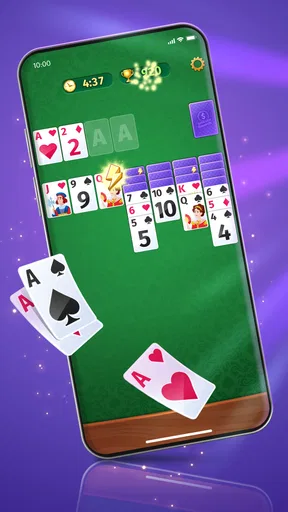
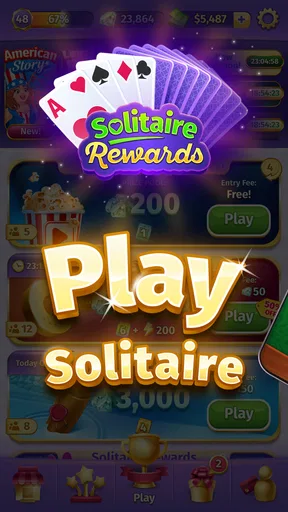
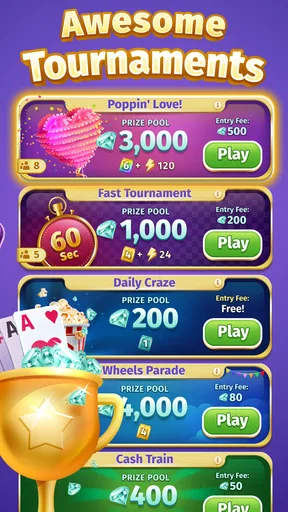
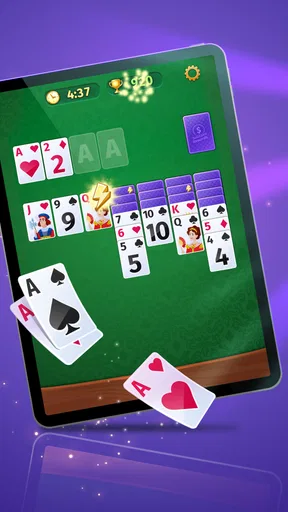
Our Review of Solitaire Rewards
 Analysis by Appyee
I spent time with Solitaire Rewards from Apperfun, a free card game built around a very familiar idea: sit down, play Solitaire, and make short sessions feel worthwhile through its reward-focused presentation. That simple promise is also the game’s main appeal. It does not ask me to learn a complicated ruleset or commit to a long multiplayer match. I can open it when I have a few quiet minutes, arrange cards, and leave whenever I need to.
What makes this particular title worth considering is not that it reinvents Solitaire. It is the way the reward angle changes how I approach a classic solo card game. Instead of treating every deal as only a puzzle, I found myself paying more attention to completing a round cleanly and keeping a steady rhythm. That can make a familiar pastime feel more purposeful, although it also means the game is best suited to people who enjoy light progression rather than a completely stripped-back card table.
It belongs to the card game category, carries an Everyone content rating, and is free to install. The current version is 15.54.34, and it runs on Android 7.0 or later. Its 4.8 average from around 2.2 thousand ratings suggests that the basic experience is connecting with many players, while more than 100 thousand installs show that it has already found a reasonable audience for a straightforward Solitaire app.
The reward-focused Solitaire experience
I look at Solitaire Rewards as a familiar card puzzle with a little extra purpose attached: its reward-focused framing can make it easier to set a goal for a quick session, while the actual appeal still comes from thinking through the cards. I’ll start with what that means for a first round, then consider how progress and challenge may shape the urge to keep playing.
Why the central capability matters
The most important capability here is the connection between ordinary Solitaire play and rewards. In practical terms, that gives each completed game a little more context than a traditional offline card layout. I am not simply moving cards until the board is clear; I am also working toward the satisfaction of finishing a session and seeing that effort recognized inside the game.
That distinction sounds small, but it affects the mood of each round. Classic Solitaire can be relaxing when I want a quiet puzzle, yet it can also feel repetitive after several games. A reward-oriented structure gives me a reason to play one more deal. For a short break, that extra motivation is useful. It creates a gentle loop: start a game, make decisions, finish if possible, and return later when I want another quick challenge.
I would not describe the reward element as a replacement for strong card gameplay. The underlying appeal still comes from planning moves, exposing hidden cards, and deciding when to hold back a useful card. If someone dislikes Solitaire itself, the reward framing is unlikely to change their mind. It works best as an added layer for people who already like the basic activity.
The reward system is most effective when it supports the card game rather than distracting from it. That is the standard I used while judging the app. A good session should still feel like I solved or nearly solved a layout, not merely tapped through a sequence to reach an unrelated prize screen.
What the app is really offering
The store summary is simply “Play Solitaire,” while the short description presents it as “Solitaire Rewards.” That combination tells me exactly where to set expectations. This is a familiar card pastime with an incentive layer, not a story-driven adventure, a competitive online league, or a deep collection game.
That focus is a positive for accessibility. A new player can understand the purpose immediately, and an experienced Solitaire player does not need a lengthy tutorial to recognize the board. The Everyone rating also fits the approachable nature of the concept. I could recommend it to someone who wants a low-pressure card game without asking them to learn a large set of systems first.
At the same time, the straightforward design may feel limited to players who want constant novelty. The reward concept can make repeated rounds feel more directed, but it cannot turn every deal into a new genre of challenge. If your ideal card game includes opponents, deck-building, dramatic animations, or a long-term campaign, this is probably too focused and modest for your tastes.
How it fits into a normal day
My favorite use case is the kind of spare time that is too short for a larger game but long enough to need a mental break. Imagine waiting for an appointment or sitting with a coffee while a download finishes. I can start a Solitaire round, concentrate on the available moves, and stop after the game instead of being pulled into a large narrative or a demanding match.
The reward emphasis helps in that situation because it gives the session a clear endpoint. I am not opening the app with the vague intention of wandering through menus. I have a simple task in front of me: play a round and see how far I can take it. That makes the game a better fit for short, repeatable breaks than for an evening when I want a substantial entertainment experience.
Another useful scenario is winding down without using a game that demands fast reactions. Solitaire lets me think at my own pace. I can examine the visible cards, consider whether a move will expose something useful, and avoid rushing. The reward layer adds a little purpose while preserving the calm, turn-based nature of the activity.
How I approach each round
The best way to get more from this type of game is to avoid treating every available move as equally good. I try to reveal hidden cards whenever that is sensible, but I do not automatically empty a column just because I can. A move that looks helpful now may remove the flexibility needed for a later sequence.
That is one of the less obvious strengths of using a reward-oriented Solitaire app: the extra motivation encourages me to play with more intention. If I am only killing time, I may make careless moves and restart quickly. When I want to complete the session successfully, I pay closer attention to the order in which cards become available. The reward goal therefore works as a small discipline tool, not just a decoration.
I also recommend treating the first few rounds as a way to discover your own pace. Some players will want to move quickly and accept occasional failed layouts. I prefer a slower approach when I am trying to finish cleanly. Neither style is wrong, but the reward focus is more satisfying for me when I make deliberate decisions rather than tapping rapidly through the board.
A practical routine for short sessions
For a five-minute break, I would open the game with one clear intention: complete a single round if possible, then stop. That prevents the reward loop from turning a small pause into an unplanned, longer session. I would also avoid starting immediately before something important, because even a simple card game can make “one more round” tempting when progress feels close.
For a longer quiet period, I would alternate between focused rounds and short pauses. Looking at the board continuously can make obvious moves harder to see, especially when several card stacks are competing for attention. A brief reset helps me return with a clearer view. This is a small habit, but it makes the game feel less like repetitive tapping and more like a sequence of manageable puzzles.
My other tip is to judge the reward structure by how it affects your enjoyment, not by chasing it automatically. If the reward goal makes a round more engaging, use it as motivation. If it starts making the game feel like a chore, return to the card decisions themselves. Solitaire is at its best when the incentive adds direction without replacing the satisfaction of solving the layout.
Where it compares well with ordinary alternatives
Compared with a plain Solitaire implementation, this game has a clearer reason to return. A minimal version may be preferable when I want nothing except cards and a quiet board, but the reward presentation can make repeated play feel less empty. That is the main difference I noticed in terms of purpose rather than rules.
Compared with multiplayer card games, it is much less demanding. There is no need to wait for another person, match someone else’s speed, or worry about a competitive result. That makes it a better choice for solitary breaks and a worse choice for anyone who enjoys bluffing, social interaction, or the pressure of a live opponent.
Compared with larger mobile games, it is easier to pick up and put down. I do not need to remember a complicated story or maintain a large set of characters. The trade-off is obvious: the experience has less variety and fewer layers. I would choose this when I want a focused card activity, not when I want my phone to provide a complete evening of changing content.
The trade-off behind rewards
The reward concept is also the main point I would examine carefully before recommending the app. Rewards can make a familiar game feel more motivating, but they can also shift attention away from the quality of the round. If I begin evaluating every move only by how quickly it brings me closer to the next reward, the relaxing side of Solitaire becomes weaker.
That trade-off matters for different personalities. Someone who likes visible goals and repeated progress may find the structure encouraging. Someone who prefers a pure, distraction-free card table may see the same structure as unnecessary. Neither reaction is surprising, and it is why I would not call the reward layer universally better than a basic Solitaire app.
I also think the free model should be approached with sensible expectations. Free games often need to make their progression noticeable, and that can affect the rhythm of play. I would pay attention to whether the reward prompts feel like a helpful part of the session or whether they interrupt the card decisions. If uninterrupted concentration is your priority, a simpler alternative may suit you better.
What the technical details mean for users
The Android requirement of 7.0 or later is helpful for people using older compatible phones. It means the game is not limited to only the newest devices, which suits a lightweight card experience. I would still keep the app updated to version 15.54.34 when an update is available, since current versions are generally the sensible starting point for stability and compatibility.
The developer is Apperfun, and the game’s audience appears broad rather than specialized. Its Everyone rating makes it easy to consider for a family device or for a relative who wants a simple pastime. I would still explain the reward-centered approach before recommending it, because age suitability and personal preference are separate questions.
Its free price also lowers the barrier to trying it. You can decide from actual play whether the reward loop adds enough value for you. That is important here because the concept is easy to understand, but the right fit depends heavily on whether you enjoy returning to the same classic card format with an added goal.
Who gains the most from this format
I think the strongest audience is made up of casual Solitaire players who want a reason to keep coming back. If you already enjoy arranging cards but sometimes stop because the routine feels too familiar, the reward angle may give your sessions a useful nudge. It is especially suitable for people who prefer solo play, short rounds, and decisions that do not require fast reflexes.
It can also work well for someone returning to mobile card games after a long break. The basic idea is recognizable, the content rating is Everyone, and the game does not demand that the player understand a large universe of characters or systems. I would introduce it as an easygoing, goal-oriented Solitaire option rather than as a major new gaming experience.
I would be more cautious about recommending it to dedicated tournament players, social card fans, or people who want deep strategic variety. Those users may be happier with a competitive card platform or a more elaborate Solitaire collection. Likewise, if you want a completely quiet interface with no incentive layer shaping your choices, a traditional minimalist app may be a better match.
My final recommendation
After using it, I see Solitaire Rewards as a focused option for players who like the classic card puzzle but appreciate a little extra motivation. Its strongest quality is the way the reward idea gives ordinary rounds a clearer sense of purpose. That makes it easy to fit into a commute, a waiting period, or a calm break at home.
I would not choose it for social competition or deep long-term variety, and I would not recommend it blindly to someone who wants Solitaire in its most stripped-down form. The reward layer is a genuine preference point: for some players it will make the routine more engaging, while for others it may feel like an unnecessary distraction.
For me, the balance is favorable because the central activity remains familiar and approachable. The free price makes trying it low-risk, the Everyone rating broadens its audience, and the strong average rating from around 2.2 thousand ratings indicates that many players are enjoying the overall formula. If you want a simple card game with a reason to complete another round, Solitaire Rewards is worth a try; if you want a pure, competitive, or highly varied card experience, I would look elsewhere.
Privacy and Permissions
See what permissions an app requests and how it handles your data.
- Location
- approximate location (network-based), precise location (GPS and network-based)
- Photos/Media/Files
- read the contents of your USB storage, modify or delete the contents of your USB storage
- Storage
- read the contents of your USB storage, modify or delete the contents of your USB storage
- Wi-Fi connection information
- view Wi-Fi connections
- Other
- view network connections, full network access, run at startup, control vibration, prevent device from sleeping, Google Play license check
Verdict
Strengths of Solitaire Rewards
- Classic solitaire rules are easy to learn for new and casual players.
- Short rounds make it convenient for quick breaks or daily play.
- Reward goals can add extra motivation beyond simply completing games.
- Simple card gameplay is suitable for a wide range of ages.
- Progress tracking can encourage regular play and continued improvement.
Limitations of Solitaire Rewards
- Rewards may require considerable time or repeated gameplay to accumulate.
- Earning opportunities can vary depending on location or account status.
- Frequent ads may interrupt games, especially for free users.
- Some features may depend on an active internet connection.
- Reward-focused play may feel repetitive for experienced solitaire players.
Other Releases by Apperfun
View All
Blingz
Entertainment4.6
Similar Picks in This Category
View All
Solitaire - Classic Card Games
MobilityWare4.6

UNO!™
Mattel163 Limited4.3

Spider Solitaire: Card Games
MobilityWare4.6

Solitaire.com - Classic Cards
Tripledot Studios Limited4.7

Plants vs. Zombies™ Heroes
ELECTRONIC ARTS4.1

Hearthstone
Blizzard Entertainment, Inc.4.1
Frequently Asked Questions
What is Solitaire Rewards, and how does the game work?
Solitaire Rewards is a mobile card game based on the classic Klondike solitaire format. You complete deals by arranging cards in descending order and alternating colors, then build each suit from Ace to King. Depending on the version and available promotions, successful games may provide points, coins, tickets, or other rewards. The exact reward system can vary by location, account status, and current in-app offers.
Can I really earn cash or prizes by playing Solitaire Rewards?
Solitaire Rewards may advertise opportunities to collect rewards while playing solitaire, but users should not assume that every player will receive guaranteed cash payments. Rewards can depend on completing eligible challenges, reaching withdrawal requirements, following promotional rules, and living in a supported region. Before investing significant time, carefully check the app’s terms, payout conditions, minimum withdrawal amount, and any restrictions that apply.
Is Solitaire Rewards free to download and play?
The app is generally available to download without an upfront purchase, allowing users to start playing basic solitaire games for free. However, free games may include advertisements, optional purchases, energy systems, or limits on how frequently rewards can be collected. Review the store listing and in-app purchase details before downloading, especially if the device is shared with children or connected to a payment method.
Does Solitaire Rewards require an account or personal information?
Solitaire Rewards may request an account, email address, social login, or other information to save progress and manage rewards. If the app supports withdrawals, it could also require additional details for payment verification or fraud prevention. Read the privacy policy before registering and only provide information through official in-app screens. Avoid unofficial websites or messages asking for passwords, payment details, or verification codes.
What should I know about advertisements, withdrawals, and app limitations?
Advertisements can be an important part of the Solitaire Rewards experience, particularly when claiming bonuses, receiving extra turns, or unlocking additional opportunities. Withdrawal requests may also be subject to minimum balances, processing times, identity checks, regional availability, and changing promotional rules. Results are not guaranteed, and the app should be treated as entertainment rather than a dependable source of income. Check current terms before playing for rewards.
Play our best games!


